

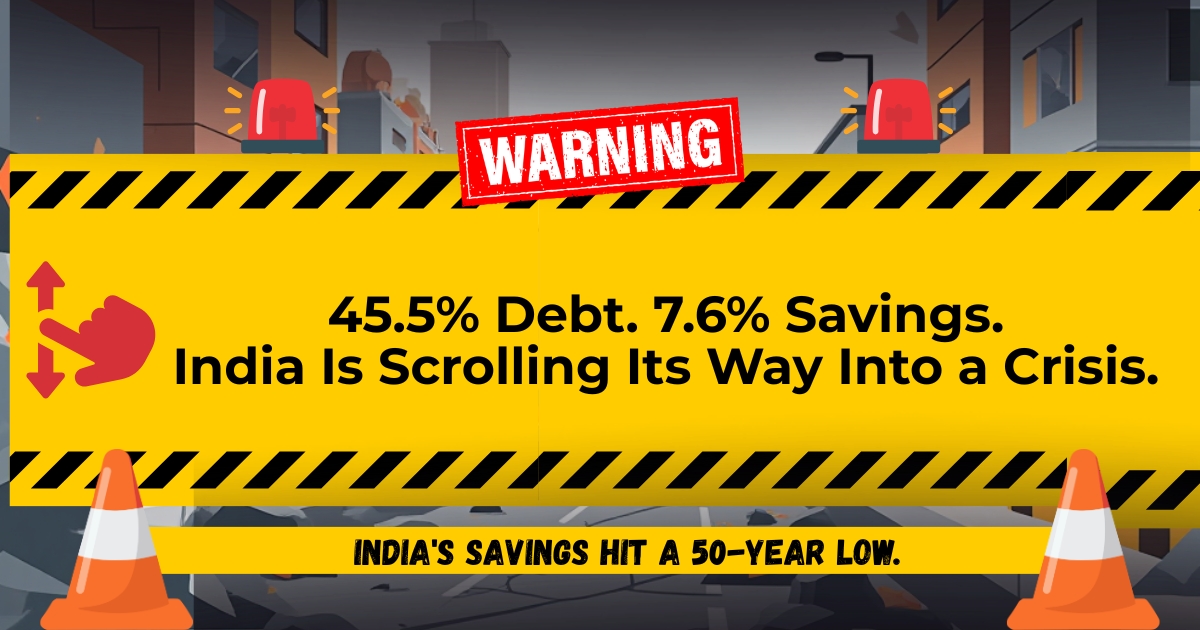
India's savings hit a 50-year low. Its finance content hit an all-time high. Something broke.
By Ashutosh Swami · Founder, Arthtosh — Wealth & Happiness ·
AMFI Registered Mutual Fund Distributor · NISM Certified Investment Advisor & Research Analyst
There is a strange habit in Indian homes today.
We are watching more financial advice than ever before. SIP reels at breakfast. “Retire at 40” podcasts on the commute. Ten-second videos selling “secrets the rich won't tell you.” If knowledge alone built wealth, India's middle class would be the safest in the world.
The truth is the opposite. We are confusing the feeling of planning with actual planning.
The numbers tell the story. Net household financial savings in India fell to a near 50-year low of 5.1% of GDP in FY23 — recovering only to 7.6% by Q4 FY25. Over the same period, household debt has climbed to 45.5% of GDP as of September 2025 — the highest level in recent years, per the RBI Financial Stability Report of June 2026. The middle-class family is saving less and owing more than it did five years ago. If a real economic shock comes, this gap will decide which families absorb it — and which families quietly break.
This article is not to blame anyone. It is to wake people up.
1. The Hidden Bleed: Consumption Loans
Reels love to debate equity vs gold vs real estate. They almost never talk about the real leak — the EMIs you pay every month.
Out of every ₹100 the Indian household borrows, ₹58 is non-housing debt — personal loans, credit cards, vehicle loans, consumer durables (RBI FSR, June 2026). This share has climbed from about 50% in 2019-20 to 58.4% by March 2026. This is consumption debt. It does not build an asset. It only eats the salary.
Credit cards are the worst offender. A revolving credit card balance costs 36% to 48% per year. On just ₹1 lakh outstanding, the family pays around ₹4,000 every month — only as interest. No SIP, no stock, no mutual fund in the world can out-earn a 40% loss.
Reels will sell you the next trading strategy. They will not tell you that clearing your credit card first is worth more than any SIP.
2. The Health Insurance Blindspot
Health insurance does not earn views on Instagram. So creators ignore it. But this is where families silently lose lakhs.
Medical inflation in India is 12–14% per year — the highest in Asia. A ₹5 lakh cover today will buy only about ₹2.8 lakh of treatment five years later. And out-of-pocket health spending is still 39% of total medical bills in India. In simple words: if the hospital bill is ₹15 lakh, your family pays around ₹6 lakh from its own pocket — even with insurance. One major hospitalisation can wipe out a decade of savings.
The fix is shockingly cheap. A ₹50 lakh super top-up on a base policy usually costs ₹3,000 to ₹15,000 extra per year. It is the single highest-return decision a middle-class family can make. Most scrollers miss it completely.
Worse: new term insurance policies in India fell 7.4% in FY25 even though premiums collected went up. Life insurance penetration has now declined for the third consecutive year — from a pandemic peak of 4.2% down to 2.7% in FY25 (IRDAI Annual Report 2024-25). Total insurance penetration is just 3.7% of GDP — half the global average of 7.3%. India is getting more under-insured, not less.
3. The “Do It Yourself” Trap
Many free reels and ₹99 masterclasses end with one ask — a course costing ₹10,000 to ₹1 lakh. The promise: you can do it yourself.
But “doing it yourself” means reading scheme documents, building your own asset mix, modelling your insurance need, doing your own tax planning, and re-doing all of it every time life changes. Most people who say “I will do it myself” are actually watching others do it on screen. That is not the same thing.
Meanwhile, families still fall into older traps too — endowment and money-back policies where they pay ₹40,000–₹50,000 a year for only ₹5 lakh cover, because someone mixed insurance with investment. A pure term plan gives ₹1 crore cover for ₹10,000–₹17,000 a year. The math is brutal. The mis-selling is daily.
4. How to Choose the Right Advisor — Without Hesitation
Many people hesitate to meet a planner. They worry about judgment. They worry about being pushed a product. They worry about cost.
A real financial planner is a professional — like a family doctor or lawyer. Their first job is to diagnose, not sell. The right one is easy to spot: the first meeting maps your situation, not a policy; they start with emergency fund, insurance, and debt — not the latest fund; they protect first, then grow; and they are transparent about how they earn.
5. The Real Cost: Delay and Panic
Most people know wrong decisions cost money. Very few understand that delay costs more.
The early years of compounding are the most powerful ones. A family that postpones planning by even three years loses lakhs at retirement — not because the market failed, but because time was lost. Time cannot be bought back.
And then there is churn. India's SIP stoppage ratio — the number of SIPs closed or matured for every 100 new SIPs opened — crossed 100% in both March and April 2026 (AMFI). In plain English: more SIP accounts were ending than starting each month. Historically this ratio has averaged around 50%. Not every closure is panic — some SIPs naturally complete their planned tenure, and AMFI's May 2025 folio reconciliation cleaned up dormant accounts. But the jump is real, and the pattern is clear: when markets fall, families still pull SIPs. And the money that gets pulled during a fall is almost never the money that comes back for the recovery.
The irony: monthly SIP inflows hit a record ₹32,087 crore in March 2026, followed by ₹31,115 crore in April 2026 — even with foreign investors selling and oil prices shocking the rupee. The families with a plan are quietly buying when others are running away. That is what discipline looks like.
What a Real Plan Actually Does
A financial plan does not start with where to invest. It starts with how to survive.
Emergency fund covering 6–12 months of essential expenses. Term insurance to replace family income for 15 years. Health cover — base policy plus super top-up, at least ₹25–50 lakh combined. Credit card balance at zero. Total EMIs under 40% of take-home pay. Business owners — personal money kept strictly separate from business cash flow.
Only after this foundation comes wealth creation — SIPs, NPS, asset allocation, rebalancing. Crisis management first. Aggressive investing second. Done in this order, no reel can shake you, no headline can panic you, and no fear-driven content can change your decision.
The One Step This Week
Not next quarter. Not after the next bonus. Not when “things settle.” This week.
Close the reel. List your goals. List your insurance. List your loans. List your savings. Then either plan it yourself — or sit with a qualified advisor who works without judgment and without hidden products.
The families that quietly survive every crisis are not the ones watching the smartest reels. They are the ones with the simplest plans, started on time.
Sources & References
- RBI Financial Stability Report, June 2026 — Household debt at 45.5% of GDP (as of September 2025); non-housing retail loans at 58.4% of total household debt (March 2026); bank gross NPAs at multi-decade low of 1.8%.
- RBI Financial Stability Report, December 2025 — Net household financial savings at 7.6% of GDP (Q4 FY25), recovering from 5.1% in FY23 (near 50-year low).
- RBI Handbook of Statistics on the Indian Economy, 2025 — Multi-year savings and debt flow data.
- IRDAI Annual Report 2024-25 (released December 2025) — Overall insurance penetration flat at 3.7% of GDP; life insurance penetration down to 2.7% (from 2.8% prior year), third consecutive year of decline; new individual life insurance policies down 7.39% YoY.
- Ministry of Health & Family Welfare — National Health Accounts 2021-22 — Out-of-pocket health expenditure at 39% of total health spend.
- NITI Aayog; Onsurity Study 2026 — Medical inflation 12–14% per year, highest in Asia.
- AMFI Industry Data (March and April 2026) — Record monthly SIP inflow of ₹32,087 crore (March 2026), ₹31,115 crore (April 2026); SIP stoppage ratio exceeded 100% in both months; historical multi-year average approximately 76%.
- Swiss Re Sigma World Insurance Report 2024 — Global insurance penetration at 7.3% of GDP; India ranked 10th largest insurance market by nominal premium volumes.
About the Author
Ashutosh Swami is the founder of Arthtosh — Wealth & Happiness, a Miraj & Pune-based financial advisory practice. AMFI Registered Mutual Fund Distributor and NISM Certified Investment Advisor & Research Analyst, he has helped over 300 families design and implement written financial plans.
Website: arthtosh.com